Professional Employer Organization Guide: HR Administration, Payroll, and Workforce Support
A Professional Employer Organization, commonly called a PEO, is a company that enters into a contractual relationship with a business to support selected employment and human-resources functions.
A PEO may assist with payroll administration, employee records, benefits coordination, HR policies, workplace compliance, risk management, and other workforce-related activities. The business generally continues to manage its daily operations and direct employees’ work.
PEO arrangements are often described as involving co-employment. This means the PEO and client business may share certain employer responsibilities under the applicable agreement and law. The exact allocation of responsibilities depends on the arrangement, state requirements, employment rules, and the services included in the contract.
What Does a PEO Do?
A PEO can support several areas of workforce administration.
Common functions may include:
Payroll processing
Payroll tax administration
Employee onboarding records
Benefits coordination
Human-resources policies
Employee handbook development
Workplace compliance support
Workers’ compensation administration
Risk-management assistance
Employment documentation
HR reporting
Employee record maintenance
Leave and attendance administration
Training coordination
Support with employee questions
The client business normally remains responsible for business strategy, employee supervision, work assignments, performance decisions, and day-to-day operations.
PEO and Co-Employment
Co-employment is one of the most important concepts in a PEO relationship.
Under a typical arrangement:
Client Business
Directs daily employee work
Makes operational decisions
Supervises employees
Determines business goals
Makes hiring and termination decisions according to the agreement and law
Controls workplace activities
PEO
Handles agreed HR administration
Supports payroll and tax processes
Coordinates selected benefits
Maintains designated employment records
Helps with certain compliance activities
May support workers’ compensation and risk-management processes
Co-employment does not mean that the PEO automatically controls every employment decision. The contract should clearly identify which responsibilities remain with the business and which are assigned to the PEO.
Businesses should review provisions covering employee supervision, payroll tax obligations, benefits, insurance, record access, confidentiality, termination, and contract cancellation.
Payroll Administration
Payroll is a common reason businesses consider a PEO arrangement.
Payroll-related activities may include:
Employee wage calculations
Overtime calculations
Payroll schedules
Direct-deposit coordination
Payroll deductions
Benefit deductions
Payroll reports
Wage statements
Federal payroll-tax processing
State payroll-tax administration
Payroll record organization
Payroll reconciliation
Businesses should confirm how payroll taxes are calculated, deposited, reported, and corrected.
A PEO arrangement does not remove the need for accurate employee information. Businesses should review:
Employee names and addresses
Tax forms
Wage rates
Work locations
Employee classifications
Benefit elections
Leave information
Payroll adjustments
Bonuses and commissions
Tax withholding details
The agreement should also explain who is responsible for correcting payroll errors and responding to tax notices.
Federal Payroll Tax Responsibilities
PEO payroll arrangements can involve federal employment-tax rules and specific reporting procedures.
The IRS recognizes different types of third-party payroll arrangements, including professional employer organizations, certified professional employer organizations, reporting agents, and other payroll providers.
A Certified Professional Employer Organization, or CPEO, is a PEO that has received certification under the IRS program and meets applicable requirements. CPEO treatment can affect certain federal employment-tax responsibilities and reporting procedures.
Businesses should not assume that every PEO receives the same federal tax treatment. Before entering an agreement, the business should confirm:
Whether the PEO is IRS-certified
Which employer identification number is used
Who deposits payroll taxes
Who files employment-tax returns
How tax notices are handled
How payroll corrections are reported
What happens if the contract ends
Which records the client can access
Current IRS guidance should be reviewed for the relevant tax year and arrangement.
Human Resources Administration
A PEO may help organize HR processes so that business owners and managers can focus on operations.
HR administration may include:
Employee onboarding
Policy documentation
Personnel records
Employee handbooks
Leave administration
Performance documentation
Workplace notices
HR forms
Employee communications
Training records
Workplace investigations support
Separation documentation
The client business should maintain clear approval procedures for employment decisions. Policies should also be adapted to the organization’s size, industry, workforce, and location.
A general PEO policy may not automatically satisfy every state or local requirement. Businesses operating in multiple states should review requirements for each employee’s work location.
Employee Benefits Coordination
PEOs may coordinate access to employee-benefit arrangements through their broader employer structure.
Potential benefit categories include:
Health insurance
Dental coverage
Vision coverage
Retirement plans
Flexible spending arrangements
Health savings accounts
Employee assistance programs
Disability coverage
Life insurance
Wellness programs
Benefits differ among PEOs and may depend on workforce size, employee eligibility, plan design, location, underwriting, and contract terms.
Businesses should examine:
Employee eligibility rules
Waiting periods
Employee contribution amounts
Employer contribution requirements
Plan documents
Enrollment procedures
Coverage limitations
Renewal terms
Continuation coverage obligations
Retirement-plan responsibilities
Data privacy practices
The PEO agreement should identify who communicates benefit information and who handles employee questions or disputes.
Employment Compliance
A PEO may help a business organize employment compliance, but legal responsibility is not automatically transferred for every issue.
Relevant areas may include:
Wage and hour rules
Minimum-wage requirements
Overtime rules
Employee classification
Workplace posters
Leave requirements
Anti-discrimination rules
Workplace safety
Employee records
New-hire reporting
Workers’ compensation
Benefits compliance
State payroll registration
Immigration-related employment documentation
The applicable requirements depend on the business, workforce, industry, location, and employee classification.
Businesses should establish a process for reviewing compliance recommendations and confirming that policies match actual workplace practices.
Workers’ Compensation and Risk Management
Some PEO arrangements include workers’ compensation coordination and workplace risk-management support.
Possible activities include:
Workers’ compensation policy coordination
Claims administration
Workplace safety documentation
Incident reporting
Safety training records
Return-to-work coordination
Risk assessments
Workplace inspection support
Employee injury documentation
Businesses should review the insurance structure carefully. Important questions include:
Which entity is the named insured?
Who controls claims decisions?
What deductibles apply?
Are there state-specific requirements?
How are workplace incidents reported?
What happens when an employee changes location?
What happens when the PEO contract ends?
A PEO does not eliminate the need for safe workplace practices or prompt reporting of workplace incidents.
PEO vs. Payroll Company
A payroll company generally focuses on payroll processing and related administrative functions. A PEO arrangement may cover a broader range of HR, benefits, employment records, compliance, and risk-management activities.
| Area | Payroll Company | PEO |
|---|---|---|
| Payroll processing | Common | Common |
| Payroll tax support | Common | Common |
| HR administration | May be limited | Often broader |
| Employee benefits | May be separate | May be coordinated |
| Co-employment arrangement | Generally not typical | Common feature |
| Workers’ compensation | May be separate | May be coordinated |
| HR policies | May be limited | Often included |
| Employment records | Depends on agreement | Often shared or maintained under contract |
| Compliance support | Varies | Often broader |
| Daily employee supervision | Client business | Client business |
The correct arrangement depends on the organization’s needs, internal capabilities, workforce structure, and risk profile.
PEO vs. Administrative Services Organization
An Administrative Services Organization, or ASO, may provide payroll, HR administration, benefits administration, and related support without the same co-employment structure commonly associated with a PEO.
Under an ASO arrangement, the client business generally remains the employer of record for the relevant functions. The organization may retain more direct control over payroll, benefits, and employment administration, depending on the agreement.
A PEO and ASO can differ in:
Employer structure
Payroll-tax treatment
Benefits arrangements
Workers’ compensation structure
HR responsibilities
Data ownership
Compliance allocation
Contract terms
Administrative control
Businesses should compare the legal and operational structure rather than focusing only on the feature list.
PEO Contract Review
Before signing a PEO agreement, businesses should review the complete contract and related documents.
Important areas include:
Scope of work
Co-employment responsibilities
Payroll-tax obligations
Employee benefits
Insurance arrangements
Workers’ compensation
Data ownership
Confidentiality
Cybersecurity
Record access
Audit rights
Fees and additional charges
Contract duration
Renewal terms
Termination rights
Transition procedures
Indemnification
Dispute resolution
Handling of tax notices
Employee communications
The agreement should clearly explain what happens when an employee is hired, transferred, placed on leave, injured, terminated, or moved to another state.
Recent Developments and Planning Considerations
PEO arrangements continue to evolve alongside remote work, electronic payroll, cloud HR platforms, employee benefits, and changing employment rules.
Businesses reviewing a PEO relationship should consider:
Remote and hybrid employee locations
Multi-state payroll
Employee-data security
Electronic onboarding
Payroll fraud controls
Benefits communication
Employee classification
State leave requirements
Workplace safety documentation
Cybersecurity obligations
Record-retention requirements
Vendor oversight
Business continuity
The IRS CPEO program remains relevant for businesses evaluating federal employment-tax arrangements. Employers should confirm a PEO’s current certification status through appropriate IRS resources rather than relying only on marketing materials.
PEO Planning Checklist
Businesses can use this checklist when evaluating a PEO:
| Area | Key Question |
|---|---|
| Employer structure | How is co-employment defined? |
| Payroll | Who calculates and processes payroll? |
| Tax deposits | Who deposits federal and state payroll taxes? |
| Tax returns | Who files employment-tax returns? |
| CPEO status | Is the PEO IRS-certified? |
| Employee records | Who maintains and can access records? |
| Benefits | Which plans and eligibility rules apply? |
| Insurance | How are workers’ compensation and other policies structured? |
| Compliance | Which party handles each compliance responsibility? |
| Data security | How are employee records protected? |
| Multi-state work | How are employee locations managed? |
| Contract | What are the renewal and termination terms? |
| Transition | How will payroll and records be transferred if the agreement ends? |
| Oversight | How will the business review performance and compliance? |
Tools and Resources
Useful U.S. resources include:
IRS: Information about employment taxes, third-party payroll arrangements, and Certified Professional Employer Organizations.
U.S. Department of Labor: Federal wage, hour, leave, and workplace requirements.
Equal Employment Opportunity Commission: Information about workplace discrimination and employment rights.
Occupational Safety and Health Administration: Workplace safety requirements and employer responsibilities.
Internal Revenue Service Employer’s Tax Guide: Guidance concerning withholding, deposits, reporting, and employment-tax records.
State labor and tax agencies: State-specific payroll, leave, wage, and employment requirements.
PEO contract documents: The agreement, schedules, benefit materials, insurance documents, and data-protection terms should be reviewed together.
Frequently Asked Questions
What is a Professional Employer Organization?
A Professional Employer Organization, or PEO, is an organization that contracts with a business to support selected HR, payroll, benefits, records, and workforce-administration functions. A typical arrangement may involve co-employment.
What is co-employment in a PEO arrangement?
Co-employment means that the PEO and client business may share certain employer responsibilities under the agreement and applicable law. The client business generally continues directing employees’ daily work.
Does a PEO handle payroll taxes?
Many PEOs handle payroll-tax calculations, deposits, and reporting under the agreed structure. Businesses should confirm who is responsible for each obligation and whether the PEO has IRS CPEO certification.
Is a PEO the same as a payroll company?
Not necessarily. A payroll company may focus mainly on payroll processing, while a PEO may also coordinate HR administration, benefits, employment records, compliance support, and risk-management activities.
What should a business review before signing a PEO contract?
The business should review co-employment responsibilities, payroll taxes, benefits, insurance, data security, records access, compliance duties, contract termination, fees, and transition procedures.
Conclusion
A Professional Employer Organization can help businesses organize payroll, HR administration, employee records, benefits coordination, and selected compliance activities through a structured employer relationship.
The most important planning step is understanding the division of responsibility between the PEO and the client business. Payroll taxes, employee supervision, benefits, insurance, records, compliance, and data security should all be addressed in the agreement.
Businesses should compare PEO arrangements with other HR and payroll models, review current federal and state requirements, and obtain qualified professional guidance before making a significant workforce-administration decision.

Related Post...

Corporate Records Management Guide: Document Control, Retention, and Compliance Planning
Updated: September 15, 2026
Read More
Commercial Real Estate Due Diligence Guide: Property Reviews, Documents, and Risk Planning
Updated: September 16, 2026
Read More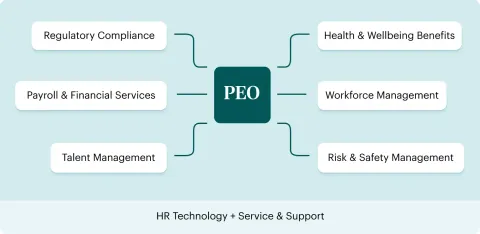
Professional Employer Organization Guide: HR Administration, Payroll, and Workforce Support
Updated: September 16, 2026
Read More