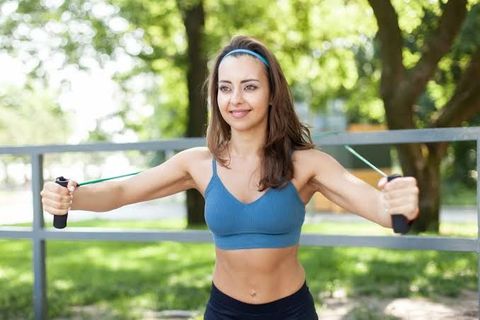
Quad Training Guide for Women: Leg Strength, Mobility, and Exercise Technique
The quadriceps are a group of muscles at the front of the thigh that help extend the knee and contribute to walking, climbing stairs, running, jumping, and squatting.
For women looking to strengthen their legs, quad-focused exercises can be combined with glute, hamstring, calf, and hip exercises to create a balanced lower-body routine.
The goal is not simply to use heavier resistance. Controlled technique, appropriate movement, and gradual progression provide a strong foundation for effective training.
Understanding Quad Training
The quadriceps work whenever the knee extends against resistance. Many everyday and strength-training movements therefore involve the quads.
Common quad-focused exercises include:
Squats
Leg presses
Step-ups
Forward lunges
Split squats
Leg extensions
Wall sits
Different exercises place different demands on the lower body.
Common Quad Exercises
| Exercise | Primary Focus |
| Squat | Quads, glutes, and overall leg strength |
| Leg Press | Supported lower-body resistance |
| Step-Up | Single-leg strength and balance |
| Forward Lunge | Quads and lower-body control |
| Split Squat | Single-leg strength |
| Leg Extension | Direct quadriceps training |
| Wall Sit | Isometric leg endurance |
Proper Exercise Technique
Good form helps maintain controlled movement and allows resistance to be increased gradually.
During quad-focused exercises:
Keep your feet stable.
Maintain controlled knee movement.
Keep the knees generally aligned with the direction of the toes.
Use a comfortable range of motion.
Avoid rushing repetitions.
Maintain stable body positioning.
Choose resistance that allows consistent technique.
Individual anatomy and mobility can affect the most comfortable stance and range of motion.
Quad Training and Mobility
Strength and mobility are separate but complementary qualities. A useful lower-body routine can include both resistance exercises and comfortable mobility work.
Examples include:
Controlled bodyweight squats
Hip mobility drills
Ankle mobility movements
Dynamic warm-ups
Gentle quadriceps stretches
Mobility exercises should be performed within a comfortable range rather than forced.
Building a Simple Quad Workout
A beginner-friendly session could include:
Bodyweight squats
Step-ups
Reverse or forward lunges
Leg presses
Gentle lower-body mobility work
Start with manageable resistance and concentrate on movement quality.
Progression Options
As technique improves, training can gradually progress through:
Additional repetitions
Additional sets
Increased resistance
More challenging variations
Controlled pauses
Improved range of motion
Gradual progression helps make changes easier to manage and monitor.
Balancing Quad Training
Although the quadriceps are important, training only one muscle group may create an incomplete routine.
Consider combining quad exercises with:
Hamstring exercises
Glute exercises
Calf training
Hip stability exercises
Core exercises
A balanced lower-body program can support overall strength and movement capacity.
Common Training Mistakes
Some common problems include:
Using excessive resistance
Allowing the knees to collapse inward
Moving too quickly
Forcing depth or range of motion
Ignoring persistent discomfort
Increasing training volume too quickly
Neglecting other lower-body muscle groups
Reducing resistance and focusing on controlled repetitions can help improve technique.
Frequently Asked Questions
What are the best quad exercises for women?
Squats, leg presses, step-ups, lunges, split squats, and leg extensions can all train the quadriceps. The most appropriate choices depend on individual goals, experience, equipment, and comfort.
Can women build strong quadriceps?
Yes. Consistent resistance training can improve quadriceps strength and lower-body capacity regardless of sex.
Do quad exercises make legs stronger?
Regular resistance training can improve leg strength over time when combined with appropriate progression and recovery.
Should women train quads and glutes together?
They can. Many lower-body exercises involve both muscle groups, and combining different movement patterns can create a balanced training session.
How often should quads be trained?
Training frequency depends on workout intensity, total weekly volume, experience, recovery, and individual goals. Adequate recovery between challenging sessions is important.
Conclusion
Quad training can help women develop leg strength, lower-body control, mobility, and exercise confidence. Exercises such as squats, leg presses, step-ups, lunges, and split squats provide practical ways to train the quadriceps.
Focus on proper positioning, controlled movement, manageable resistance, and gradual progression. Combining quad exercises with hamstring, glute, calf, hip, and core training can create a more balanced lower-body routine.
Disclaimer
This article is provided for general educational and informational purposes only and is not individualized medical or fitness advice. Exercise suitability varies between individuals. Anyone with an injury, medical condition, persistent pain, or physical limitation should consider consulting an appropriately qualified healthcare or fitness professional before beginning a new exercise routine. Stop exercising if you experience sharp, severe, or unusual pain.

Related Post...
Cosmetic Surgery Planning Guide: Procedure Options, Consultation, and Recovery Information
Updated: September 15, 2026
Read More
Functional Fitness Guide for Women: Balance, Core Strength, Mobility, and Coordination
Updated: August 17, 2026
Read More
Women’s Strength Training Guide: Lower Body Exercises, Core Stability, and Upper Body Strength
Updated: August 17, 2026
Read More