Indoor Air Quality Testing Guide: Building Assessment, Air Monitoring, and Safety Planning
Indoor air quality (IAQ) describes conditions inside buildings that can affect occupant comfort, health, and the ability to work. In commercial properties, IAQ can be influenced by ventilation, HVAC operation, moisture, building materials, cleaning activities, outdoor pollutants, remodeling, combustion sources, and occupant activities.
An indoor air quality assessment is broader than collecting an air sample. EPA guidance recommends developing an overall building profile that considers building conditions, HVAC systems, pollutant sources, moisture, occupants, and appropriate investigative strategies.
There is also no single test that can identify every IAQ problem. OSHA recommends considering building inspection, temperature, humidity, airflow, HVAC operation, and targeted testing when appropriate.
Why Indoor Air Quality Assessment Matters
Poor IAQ can have many possible causes. OSHA identifies inadequate ventilation, HVAC problems, moisture damage, indoor contaminants, and outdoor contaminants among the factors that can contribute to workplace IAQ concerns.
A structured assessment can help building managers:
Identify potential pollutant sources
Evaluate ventilation performance
Detect moisture-related conditions
Review HVAC operation and maintenance
Investigate occupant complaints
Determine whether targeted air monitoring is appropriate
Document building conditions
Prioritize corrective actions
Establish a baseline for future comparisons
IAQ assessment is particularly relevant in offices, schools, healthcare facilities, manufacturing buildings, warehouses, retail properties, and other occupied commercial spaces.
Common Indoor Air Quality Concerns
Indoor air concerns can involve several different categories.
Ventilation
Insufficient outdoor air or poor air distribution can contribute to stuffiness, odors, elevated carbon dioxide, and pollutant accumulation.
Moisture and dampness
Leaks, flooding, condensation, high humidity, and poorly maintained HVAC components can create conditions associated with mold and other biological contaminants.
Particulate matter
Dust, combustion particles, outdoor pollution, construction activity, and certain industrial processes can contribute to airborne particulate matter.
Volatile organic compounds
VOCs can originate from paints, adhesives, cleaning products, furnishings, building materials, and other sources.
Carbon monoxide
Combustion equipment, vehicle exhaust, generators, and other sources can introduce carbon monoxide into indoor environments.
Radon
Radon is a naturally occurring radioactive gas that can enter buildings from the ground. Testing may be appropriate depending on the building and location.
Biological contaminants
Mold, bacteria, allergens, and other biological materials may be associated with moisture, ventilation systems, building conditions, or specific activities.
Building Assessment Before Air Testing
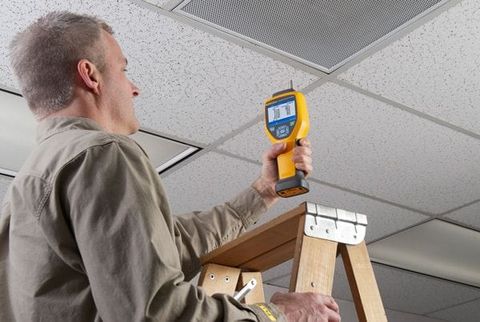
A building walkthrough should generally precede or accompany targeted air monitoring.
The assessment may examine:
Building age and construction
Occupancy and building use
Recent renovation or construction
Water intrusion
Visible moisture
Odors
HVAC equipment
Outdoor-air intake locations
Filtration
Exhaust systems
Temperature
Relative humidity
Airflow
Cleaning activities
Chemical storage
Combustion equipment
Pest activity
Occupant complaints
EPA's Building Assessment Survey and Evaluation program used building and HVAC characterization alongside environmental measurements and occupant information rather than treating air measurements as an isolated activity.
Indoor Air Quality Testing and Monitoring
Testing should be selected according to the suspected problem.
Potential measurements can include:
Temperature
Relative humidity
Carbon dioxide
Carbon monoxide
Particulate matter
VOCs
Formaldehyde
Radon
Airflow
Specific chemical contaminants
Selected biological indicators
EPA's large-building assessment work has included measurements for particles, VOCs, formaldehyde, bioaerosols, radon, temperature, relative humidity, carbon dioxide, and carbon monoxide.
Not every building requires every measurement. Testing should have a defined purpose and should be interpreted in the context of the building, sampling location, operating conditions, and applicable benchmarks.
Air Monitoring Locations
Where samples are collected can significantly affect how results are interpreted.
Depending on the investigation, monitoring locations may include:
Occupied areas
Areas where complaints are concentrated
Near suspected pollutant sources
Mechanical rooms
Areas supplied by different HVAC systems
Outdoor reference locations
Areas with visible moisture
Construction or renovation zones
EPA's BASE methodology used fixed and mobile indoor monitoring locations and an outdoor location near the fresh-air intake serving the study area.
For an individual building investigation, the sampling strategy should reflect the specific question being investigated rather than simply collecting samples at convenient locations.
HVAC and Ventilation Assessment
HVAC systems are central to indoor environmental conditions.
An assessment may review:
Outdoor-air intake
Supply-air distribution
Return-air pathways
Exhaust systems
Filters
Air-handling units
Coils and drain pans
Humidification systems
Controls
Maintenance records
Operating schedules
Ventilation rates
OSHA identifies inadequate ventilation and problems with HVAC upkeep among major contributors to workplace IAQ concerns.
CDC/NIOSH guidance recommends using applicable ventilation codes as the starting point for evaluating ventilation improvements and emphasizes maintaining HVAC systems according to their intended design.
Moisture, Mold, and Indoor Air Quality
Moisture should be considered whenever an IAQ concern involves musty odors, visible mold, water intrusion, condensation, or previous flooding.
Potential sources include:
Roof leaks
Plumbing leaks
Condensation
Flooding
Wet building materials
HVAC drain problems
High indoor humidity
Poor drainage
Moisture entering through the building envelope
OSHA identifies dampness and moisture damage from leaks, flooding, and high humidity as common contributors to IAQ problems.
Air sampling alone cannot replace a building inspection. If a moisture source is identified, addressing that source is generally an important part of the overall response.
Occupant Complaints and IAQ Investigations
Occupant reports can provide useful information about where and when a problem occurs.
Building managers may document:
Location of reported concerns
Date and time symptoms or odors occur
Whether concerns are concentrated in specific rooms
Recent renovations
Changes in occupancy
HVAC operating conditions
Cleaning or chemical activities
Weather conditions
Moisture events
Whether concerns change when occupants leave the building
OSHA notes that symptoms associated with IAQ concerns can include headaches, fatigue, difficulty concentrating, and irritation, although symptoms alone cannot establish a particular indoor contaminant as the cause.
Health concerns should be evaluated by an appropriate healthcare professional rather than diagnosed through building air testing.
Documentation and Reporting
A well-organized IAQ investigation should document both the testing and the conditions surrounding it.
A report may include:
| Assessment Area | Example Documentation |
|---|---|
| Building profile | Age, occupancy, use, construction |
| HVAC | Equipment, filters, operation, maintenance |
| Environmental conditions | Temperature, humidity, airflow |
| Air monitoring | Locations, dates, instruments, results |
| Moisture | Leaks, water damage, humidity conditions |
| Occupant concerns | Location, timing, reported observations |
| Pollutant sources | Chemicals, combustion, renovation |
| Photographs | HVAC, moisture, visible conditions |
| Corrective actions | Ventilation, maintenance, source control |
| Follow-up | Retesting or verification when appropriate |
Documentation should identify the date, location, equipment or method used, and operating conditions whenever practical.
Interpreting IAQ Test Results
An air-quality measurement should not be interpreted in isolation.
Results can depend on:
Sampling location
Sampling duration
Weather
HVAC operating conditions
Occupancy
Building activities
Instrument limitations
Laboratory methods
Applicable standards or guidelines
OSHA specifically notes that there is no single IAQ test that identifies all problems. A meaningful investigation may combine inspection, environmental measurements, HVAC evaluation, and targeted contaminant testing.
Comparing results with the appropriate regulatory limits, occupational exposure limits, building standards, manufacturer specifications, or other applicable benchmarks should be done by appropriately qualified professionals.
Safety Planning
Indoor air investigations can involve potentially hazardous environments.
Additional precautions may be appropriate when a building contains:
Unknown chemical substances
Combustion gases
Asbestos-containing materials
Significant mold contamination
Sewage contamination
Confined spaces
Construction hazards
Industrial chemicals
Oxygen-deficient or otherwise hazardous atmospheres
Certain workplaces and confined spaces can require atmospheric monitoring and specific entry controls. OSHA's confined-space requirements, for example, address hazardous atmospheres, ventilation, and atmospheric monitoring.
Testing personnel should not enter hazardous areas simply to collect measurements without an appropriate safety assessment.
Recent U.S. Considerations
EPA continues to provide building-focused IAQ guidance for commercial and public facilities, including guidance on developing an IAQ profile, investigating potential causes, evaluating mitigation approaches, and determining when outside technical expertise may be appropriate.
CDC/NIOSH ventilation guidance updated in October 2024 emphasizes maintaining appropriate outdoor-air ventilation and considering applicable ventilation codes when improving air circulation in occupied buildings.
OSHA's current IAQ guidance also emphasizes building operations, HVAC maintenance, ventilation, moisture control, and investigation of workplace IAQ concerns.
Laws, Standards, and Compliance Considerations
Indoor air requirements vary according to the building type, workplace activity, contaminant, and jurisdiction.
OSHA
OSHA does not have one comprehensive federal indoor-air-quality standard covering every workplace IAQ condition. However, OSHA has requirements addressing ventilation and specific airborne contaminants, and the General Duty Clause applies to recognized workplace hazards that can cause death or serious physical harm.
Ventilation standards
Applicable building and ventilation codes can establish requirements for ventilation design and operation. CDC/NIOSH recommends using applicable ventilation codes as an important starting point for building ventilation improvements.
State and local requirements
Some jurisdictions have additional indoor-air requirements. OSHA notes that California and New Jersey have state IAQ regulations, while other states may have different building, occupational, environmental, or public-health requirements.
Special contaminants
Separate requirements can apply to substances such as asbestos, lead, radon, formaldehyde, hazardous chemicals, and combustion gases. The appropriate regulatory framework depends on the contaminant and building circumstances.
Tools and Resources
Useful U.S. resources include:
EPA Building Air Quality Guide — building assessment, IAQ profiles, investigation strategies, HVAC considerations, moisture, and air sampling.
OSHA Indoor Air Quality guidance — workplace IAQ, ventilation, building operations, contaminants, and investigation considerations.
EPA BASE Study — information on standardized IAQ measurements and building/HVAC characterization.
CDC/NIOSH ventilation guidance — information on improving air circulation and maintaining appropriate ventilation.
Qualified industrial-hygiene professionals — appropriate for complex exposure investigations or specialized monitoring.
FAQs
1. What is indoor air quality testing?
Indoor air quality testing is the measurement or evaluation of selected environmental conditions or airborne contaminants inside a building. It is normally one part of a broader assessment that can include building inspection, HVAC evaluation, occupant information, and moisture assessment.
2. Is there one test that checks all indoor air quality problems?
No. Different IAQ concerns require different investigative approaches. OSHA specifically notes that there is no single test capable of identifying every IAQ problem.
3. What should be checked during an indoor air quality assessment?
Common areas include ventilation, HVAC operation, temperature, humidity, airflow, moisture, visible contamination, pollutant sources, occupant concerns, and targeted airborne contaminants when appropriate.
4. How often should commercial buildings test indoor air quality?
There is no universal testing interval for every commercial building. Routine building operation, HVAC maintenance, occupant concerns, renovation, moisture events, and specific regulatory requirements can determine whether additional assessment is appropriate.
5. Can air testing determine whether a building is making someone sick?
Air testing can provide useful environmental information, but it generally cannot establish a medical diagnosis by itself. Health concerns should be discussed with an appropriate healthcare professional, while building conditions should be evaluated by qualified IAQ or occupational-health professionals when warranted.
Conclusion
Indoor air quality assessment is most effective when it combines building inspection, HVAC evaluation, environmental measurements, occupant information, and targeted air monitoring.
For commercial properties, a structured approach can help identify ventilation problems, moisture conditions, pollutant sources, and other factors that may affect indoor environmental quality. Testing should be selected according to the question being investigated rather than performed as a generic checklist.
Good documentation is also important. Recording building conditions, monitoring locations, environmental measurements, HVAC information, photographs, and corrective actions creates a useful record for facility management and follow-up evaluation.

Related Post...
Electric Substation Guide: Power Distribution, Protection Systems, and Maintenance
Updated: September 15, 2026
Read More
Probate Administration Guide: Estate Settlement, Court Procedures, and Asset Planning
Updated: September 14, 2026
Read More
Asbestos Inspection Guide: Building Surveys, Risk Assessment, and Abatement Planning
Updated: September 15, 2026
Read More